
Theoretical Stock: Definition, Calculation and Best Practices

In B2B business management, effective inventory control is a strategic priority. Poorly managed inventory can lead to a range of issues, including stockouts, significant financial costs, and ultimately financial losses. However, there are several ways to monitor your inventory levels. One of these methods is theoretical stock. It allows you to track your products on a daily basis, anticipate your needs, and make more informed purchasing decisions.
In this article, we will first define theoretical stock, then explain the difference between theoretical and physical stock, present the theoretical stock formula, and explore its practical benefits for small and medium-sized businesses. Finally, we will look at how software such as Logistiqa can help you monitor your theoretical stock in real time, reduce discrepancies with physical stock, and optimize your inventory management.
What Is Theoretical Stock?
Theoretical stock is the inventory level calculated from the stock movements recorded in your software, including incoming transactions (purchases and goods receipts) and outgoing transactions (sales and shipments).
In other words, it is the amount of stock you “should” have according to your records. This accounting figure does not take into account certain real-world issues, such as damaged or stolen products or stock movements that were recorded incorrectly.
For example, consider a company that sells automotive parts:
- It starts the week with 100 parts in stock.
- It receives 50 additional automotive parts.
- It ships 30 parts.
Its theoretical stock is therefore 120 automotive parts. However, if 2 parts were damaged and another one was misplaced, its actual physical stock would be 117 parts.
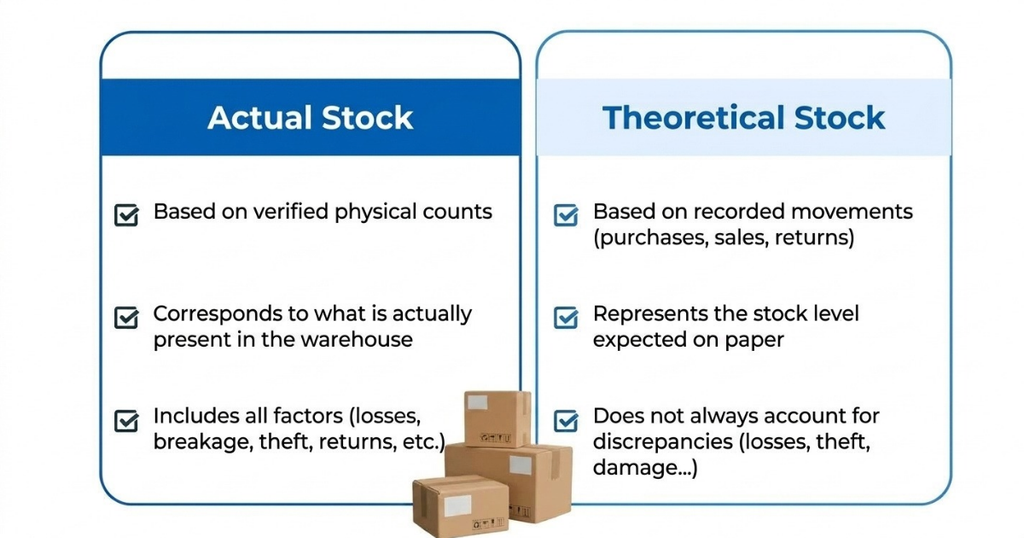
Actual Stock vs. Theoretical Stock
Differences Between Physical Stock and Theoretical Stock
Distinguishing between physical stock and theoretical stock is essential for effective inventory management:
- Actual stock (or physical stock): This refers to the inventory that is physically present in your warehouse.
- Theoretical stock (or book stock): This is based on recorded inventory movements, such as purchases, sales, and returns.
In practice, theoretical stock serves as the basis for managing your purchases and sales, but it should be regularly compared with physical stock through inventory counts.
Why Do Inventory Discrepancies Occur?
Despite careful inventory tracking, discrepancies between theoretical and actual stock can still occur.
Here are the main causes:
- Breakage and damage: A damaged product may sometimes remain included in the theoretical stock.
- Theft and losses: A missing item may go undetected for several days.
- Data entry errors: An incorrect or missing product reference or quantity entered during a sale or delivery.
- Product returns: Returned items are put back into stock, but the return is not recorded in the system.
- Expired products: An item that has passed its expiration date has not been removed from the theoretical stock.
These discrepancies, even if they may seem minor, can affect not only your profitability but also customer satisfaction. This is why it is recommended to conduct regular inventory counts to reconcile theoretical stock with physical stock.
Why Tracking Theoretical Stock Is Essential for Small and Medium-Sized Businesses
Having reliable theoretical stock data offers many benefits, particularly for B2B small and medium-sized businesses.
1. Real-Time Visibility into Your Inventory
Without waiting for a physical inventory count, you know exactly what you should have in stock. This allows you to make faster decisions about replenishment and sales strategies.
2. Better Prevention of Stockouts
By closely monitoring your outgoing stock and order forecasts, theoretical stock helps alert you when you reach your reorder point. This reduces the risk of stockouts, which can negatively affect customer satisfaction.
3. Better Cash Flow Management
Excess inventory ties up capital unnecessarily. Storage costs also reduce your margins. By keeping track of your theoretical stock, you can adjust your inventory levels more accurately and free up cash for other strategic needs.
4. Greater Reliability with Partners and Customers
If you do not have an accurate view of your inventory, you may find yourself in difficult situations, such as selling a product that is no longer in stock. Keeping your theoretical stock up to date helps you avoid these situations and maintain the trust of your customers and suppliers.
Calculating Theoretical Stock
The theoretical stock is calculated using a simple formula:
Theoretical Stock = Opening Stock + Inbound Stock (purchases, receipts) − Outbound Stock (sales, shipments)
Let’s go back to the example of the automotive parts seller:
- Opening stock: 200 parts
- Inbound stock (supplier receipts): +150
- Outbound stock (customer sales): −120
Theoretical Stock = 230 automotive parts
This calculation must be based on accurate data. Incorrect data, such as an error when recording a supplier delivery or a sale, can create discrepancies between theoretical and physical stock.

How Can You Improve the Accuracy of Your Theoretical Stock?
For your theoretical stock calculation to be truly useful, it must be based on accurate data. Here are some best practices:
1. Standardize Your Procedures
Set up a clear and easy-to-follow process for recording all stock receipts and issues. Every receipt, return, or shipment should be recorded immediately.
It is also essential to account for stock issues resulting from breakage, expired products, or defective items.
2. Conduct Regular Inventory Counts
Carry out inventory counts regularly. An annual inventory count is not enough. Cycle counts, organized by product category or storage area, help identify and correct discrepancies quickly.
3. Digitize Your Inventory Management
Choose dedicated inventory management software to automate stock updates and reduce human errors. When connected to a barcode scanner, it further minimizes the risk of data entry errors. With digital inventory management, your sales, purchases, and warehouse movements are synchronized in real time.
4. Train Your Teams
Avoid a gap between decision-makers and your operational teams. A good tool alone is not enough if users are not properly trained and do not understand the new processes.
Logistiqa, Your Partner for Reliable Theoretical Stock and Optimized Inventory Management
In B2B sales, accuracy and responsiveness are essential. Having the right tools is just as important. This is where Logistiqa makes a difference.
With its intuitive interface, Logistiqa centralizes all your sales, purchasing, and inventory data. Every stock movement is recorded automatically, including supplier receipts, customer orders, and more. As a result, your theoretical stock is always up to date, with no manual effort required.
By providing a clear, real-time view of your inventory levels, Logistiqa helps you:
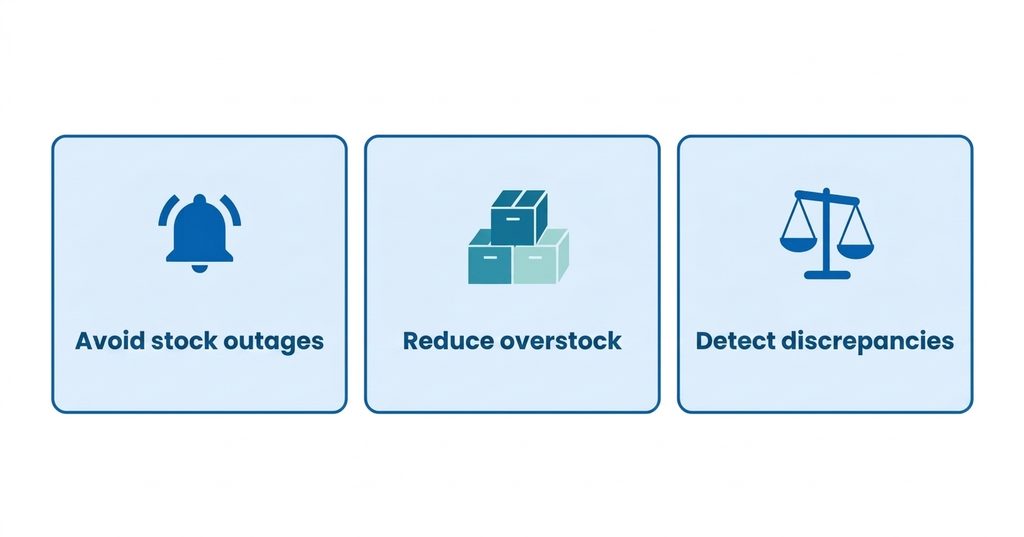
- Avoid stockouts with reorder points and customizable alerts.
- Reduce overstocking and the capital tied up in excess inventory.
- Easily compare your theoretical stock with physical inventory counts to identify discrepancies.
Theoretical stock is an essential indicator for managing your inventory on a daily basis. It gives you a real-time view of your available stock, helps optimize replenishment, and supports more reliable sales management. However, to be effective, it should always be compared with physical stock and based on reliable data and tools.
With Logistiqa, you have a complete solution to automatically calculate your theoretical stock, reduce discrepancies, and simplify inventory counts. A major asset for turning inventory management into a real growth driver for your small or medium-sized business.
Contact us by email info@logistiqa.co
Posts navigation
←Storage Costs: Definition, Calculation and Optimization for Small and Medium-Sized Businesses ?