Overstocking: How to Avoid It and What to Do When It Happens
Overstocking can slow down the growth of your B2B business. It creates additional costs, ties up valuable resources, and increases the risk of products losing value or becoming obsolete. Yet, avoiding excess inventory can be challenging without the right strategies in place. In this article, we’ll explore how to prevent overstocking through accurate demand forecasting and effective inventory management.
What Is Overstocking?
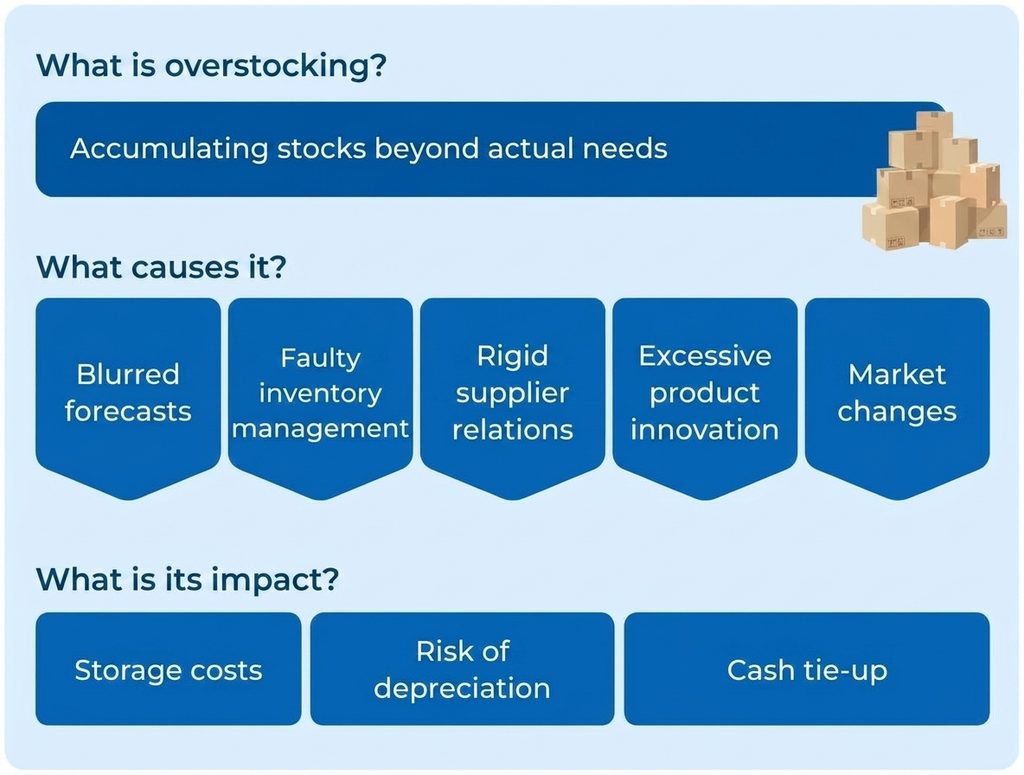
Overstocking occurs when you keep significantly more products in your warehouse than the market actually requires.
This excess inventory often results from overestimating sales or from a lack of information sharing between different departments, such as sales, marketing, and production.
For small businesses and SMEs, overstocking can lead to high storage, insurance, and maintenance costs. The longer products remain in the warehouse, the greater the risk that they will lose value or become obsolete. This ties up capital that could otherwise be invested in other areas, such as developing new products or generating new sales opportunities.
The Main Causes of Overstocking
Several factors can explain why you end up with too much inventory. The first is inaccurate sales forecasting. In B2B markets, demand can change quickly, and without reliable data, it is easy to place orders that are larger than necessary.
Another common issue is the lack of a centralized system for tracking inventory movements in real time. Without accurate, up-to-date information, you may end up ordering without knowing your actual stock levels. Rigid supplier agreements can also require you to purchase minimum quantities, even when you don’t actually need them.
Excessive product innovation is another potential cause of overstocking. If you constantly introduce new SKUs, you may end up accumulating older products that are increasingly difficult to sell. Finally, failing to adapt to market trends can leave you holding inventory for products whose demand suddenly drops.
How to Avoid Overstocking?
Forecast Demand Accurately
The first step is to improve your ability to predict future sales. Artificial intelligence and machine learning can analyze large volumes of data and anticipate changes in market demand. Some software solutions use AI to generate more accurate forecasts. In addition, the sales reports and historical data available in most online management tools allow you to analyze B2B customer behavior by reviewing their previous orders.
It is also important to encourage collaboration between your sales, marketing, and production teams. Everyone involved should have a shared understanding of demand, reducing guesswork and helping you align production with actual orders.
Manage Inventory with Agile and Innovative Methods
To optimize your inventory, you can adopt proven methods such as:
- Next-generation ERP systems and specialized software. These integrated platforms provide real-time visibility into your inventory, sales, and orders. This allows you to quickly identify discrepancies and take corrective action.
- Modern inventory management methods, such as Just-in-Time (JIT), remain an effective approach for many small businesses and B2B SMEs. By producing or purchasing only what is actually needed, you avoid filling your warehouses with unnecessary goods.
- The ABC analysis method helps classify products based on their sales volume and value, allowing you to focus on the most important items. These products can have a significant impact on your cash flow and therefore require particular attention.
- Automated inventory systems, using robotics and IoT technologies, enable frequent and accurate stock audits. This approach is generally better suited to larger companies. For smaller businesses, regular manual inventory counts may be more practical.
Build Strategic Partnerships with Suppliers
Supplier flexibility can significantly reduce overstocking. By building strong, trust-based relationships with suppliers, you can negotiate lower minimum order quantities, shorter delivery times, and faster replenishment options.
Some suppliers also allow customers to access their own management tools, making it possible to track orders in real time and adjust purchasing decisions when demand changes. This type of replenishment ecosystem helps businesses respond more effectively to fluctuations in the B2B market.
Optimize Your Product Assortment
An overly broad product range can also create inventory problems. It is essential to regularly evaluate product performance. Sales data shows you which products are selling well and which ones are sitting in your warehouse. You can then reduce the number of slow-moving or unprofitable SKUs and focus on products with stronger demand.
Your innovation team should also use this data when developing new products. By creating products that match current market trends, you can reduce the risk of accumulating obsolete inventory.
Leverage Technology and Automation
Data analytics software is becoming increasingly accessible to small businesses and SMEs. These tools help you identify changes in demand in real time and quickly adjust your production and purchasing levels.
Automating part of your supply chain can significantly improve responsiveness. For example, algorithms can automatically trigger a purchase order when a product’s stock level falls below a predefined threshold. This helps reduce the risk of overstocking while also preventing stockouts.
Train Your Teams in Inventory Management
For an inventory management system to work effectively, every employee needs to understand their role in the process. Regular training on best practices helps maintain the necessary level of expertise across the organization.
It is also important to develop a culture of accountability. Everyone, from logistics managers to sales representatives, should understand the impact inventory has on cash flow. Better communication around sales forecasts and business objectives helps prevent inconsistencies and keeps inventory decisions aligned across the company.

Solutions for Dealing with Overstocking
Despite taking every precaution, you may still end up with excess inventory. When this happens, it is important to act quickly to minimize losses.
Clearance Strategies
To clear unsold and excess inventory, you can use stock clearance platforms. These methods should remain occasional and be carefully managed to avoid damaging your brand image.
You can also donate excess goods to charities or nonprofit organizations. Depending on local tax regulations, this can sometimes be more cost-effective than recycling or clearance sales, thanks to potential tax benefits.
Product Bundles and Special Offers
You can use targeted promotions or create product bundles to move excess inventory more quickly.
Products can be offered as discounted bundles, or different items can be sold together. This allows you to combine a slow-moving product with a high-demand item, making the excess stock more attractive to customers.
Returns and Reuse with Suppliers
Some suppliers accept stock returns or exchanges, especially when flexible terms have been negotiated in advance. This solution can help you avoid losing the full value of your inventory.
Social Responsibility and Recycling
Donating goods to charities or participating in recycling programs can strengthen your corporate social responsibility (CSR) initiatives. You can limit financial losses while also demonstrating your commitment to social and environmental responsibility.
Post-Crisis Review and Optimization
Once the excess inventory has been reduced, it is essential to analyze the reasons behind the accumulation. You should review your demand forecasts, supplier relationships, and even your product assortment. The lessons learned can help you avoid making the same mistakes in the future.
Maximizing Inventory Turnover
To prevent the problem from happening again, you need to implement an effective inventory rotation system. The FIFO (First In, First Out) method ensures that older products are sold first, preventing them from remaining in stock for too long. You should also continuously adjust inventory levels based on sales and changing market trends.
Why Implement Inventory Management Software?
Adopting inventory management software is one of the most effective ways to maintain a comprehensive view of your products, automate repetitive tasks, and keep inventory levels under control.
Logistiqa centralizes and continuously updates your inventory data, making it much easier to manage your product catalog while helping prevent unexpected stockouts.
With Logistiqa, you can:
- Instantly access stock levels for each storage location: see exactly how much inventory is available in each warehouse or storage facility.
- Monitor inventory levels accurately: automatic updates and replenishment alerts help prevent stockouts.
- Synchronize sales data: every order or transaction automatically updates inventory in real time, ensuring reliable and transparent stock management.
- Easily add discounts: apply discounts to specific product types or create kits that combine several products into a single offer.
Logistiqa is a comprehensive SaaS solution designed to meet the needs and budgets of small businesses and SMEs. It provides the tools you need to manage your inventory efficiently, reduce excess stock, and improve overall operational performance.
Posts navigation
← Shrinkage Rate: How to Identify Hidden Inventory Losses ?
Theoretical Stock: Definition, Calculation and Best Practices ? →