
How to Conduct a Reliable Inventory Count Without Slowing Down Your Business?

In a trading, distribution, or B2B e-commerce business, inventory counting is a key management tool. It is not simply about counting products, but about having a reliable view of what the company actually owns, so that purchasing, sales, and financial management can be properly aligned.
Without rigorous inventory counting, decisions are based on approximate data. Conversely, a well-organized inventory count helps secure logistics operations, prevent inventory discrepancies, and improve overall profitability.
Understanding Inventory Counting
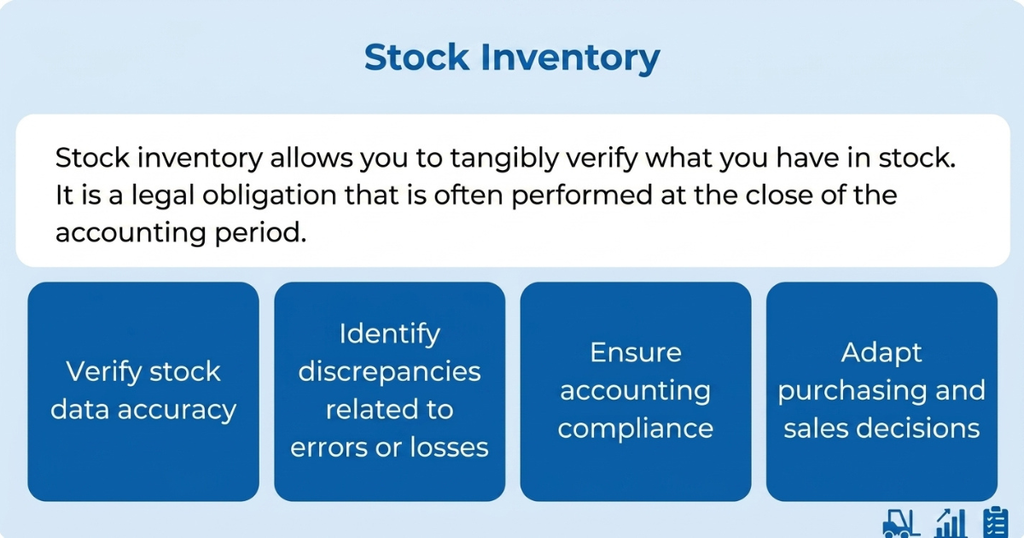
Inventory counting presents a dual challenge for a business. On the one hand, it is a legal requirement, as it must be carried out at least once a year, generally at the end of the financial year. On the other hand, it is a genuine management tool, as it makes it possible to accurately verify the quantities actually available and ensure the reliability of the data used on a daily basis.
This operation plays several key roles:
- Verify the accuracy of inventory data
- Identify discrepancies caused by errors, losses, or incorrectly recorded movements
- Ensure accounting compliance by properly valuing assets
- Adjust purchasing and sales decisions
Reliable inventory counting directly contributes to the quality of customer service. A business…
Setting Up an Effective Inventory Count: Organization, Frequency, and Tools
Conducting an inventory count should not be seen as a one-off constraint, but rather as a management tool.
Regular monitoring helps prevent errors from accumulating, optimize product turnover, reduce tied-up capital, and maintain an inventory level that is consistent with actual business activity. When data is reliable, sales teams have accurate information to support sales, purchasing can be better anticipated, and overall management becomes more efficient.
An effective inventory count relies above all on preparation and methodology. The most efficient companies organize their operations in advance to minimize errors and speed up counting: organizing storage areas, clearly identifying locations, defining standardized counting procedures, and scheduling inventory operations at regular intervals.
This organization reduces errors, speeds up counting, and improves data reliability over the long term.
Different Types of Inventory Counts Used in Logistics
Not all companies organize their inventory counts in the same way. The choice depends on the volume of activity, the complexity of inventory flows, and the level of accuracy required.
Whatever method is chosen, it is recommended to involve several employees during a quieter period of activity and use a barcode scanner to improve efficiency.
Physical Inventory Count
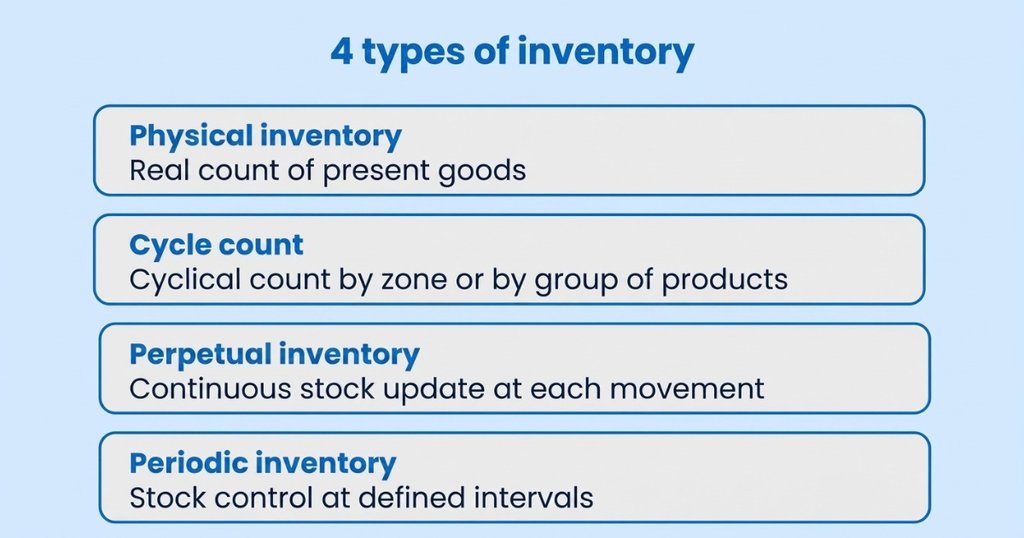
Physical inventory counting is based on an actual count of the goods present. It remains the standard method for validating inventory accuracy.
It generally involves a partial or complete suspension of inventory movements, counting each item individually, and comparing the results with the recorded data. This method is reliable, but it can be time-consuming and slow down business operations.
Cycle Counting
Cycle counting involves spreading inventory checks throughout the year rather than verifying everything at once.
Each period is dedicated to a specific area, product category, or group of items, helping maintain continuous inventory accuracy without interrupting operations while distributing the workload over time. It is now a common practice in well-structured logistics organizations.
Perpetual Inventory
Perpetual inventory relies on continuously updating stock levels after every incoming or outgoing goods movement. Quantities are updated automatically without waiting for a full physical inventory count.
It provides a real-time view of inventory levels, makes it easier to detect discrepancies, and supports more reliable purchasing and sales decisions while reducing the need for time-consuming inventory counts. It complements physical inventory checks to ensure reliable inventory tracking throughout the year.
Periodic Inventory
Periodic inventory involves checking stock levels at defined intervals (monthly, quarterly, or annually), without continuous updates between two inventory checks. Adjustments are made only at the time of the physical count.
This method is simple to implement, but it provides less accurate visibility between inventory periods.
The Limitations of Manual Inventory Management in Today’s Business Environment
Many businesses continue to manage their inventory using multiple files or manual data entry. This approach quickly reaches its limits as the business grows.
In this context, several challenges can quickly arise:
- Time-consuming re-entry of data across different systems
- A high risk of human error
- Lack of real-time visibility
- Inventory discrepancies that are difficult to explain or trace
- Significant staff involvement for an uncertain outcome
When data is not centralized, inventory counting becomes a burdensome operation that can sometimes become disconnected from the actual management of the business.
By using inventory management software, you can transform inventory counting into a continuous process integrated into daily operations. Updates are made automatically after every inventory movement, incoming and outgoing goods are tracked, and information is shared across teams. The business therefore has a reliable database without the need for repeated manual data entry.
Inventory counting is no longer an isolated event, but a continuous management tool.
How Logistiqa Simplifies Your Inventory Counts
Logistiqa includes features designed to make inventory management and counting faster, more reliable, and better suited to the operational needs of SMEs.
Real-Time Visibility into Your Inventory
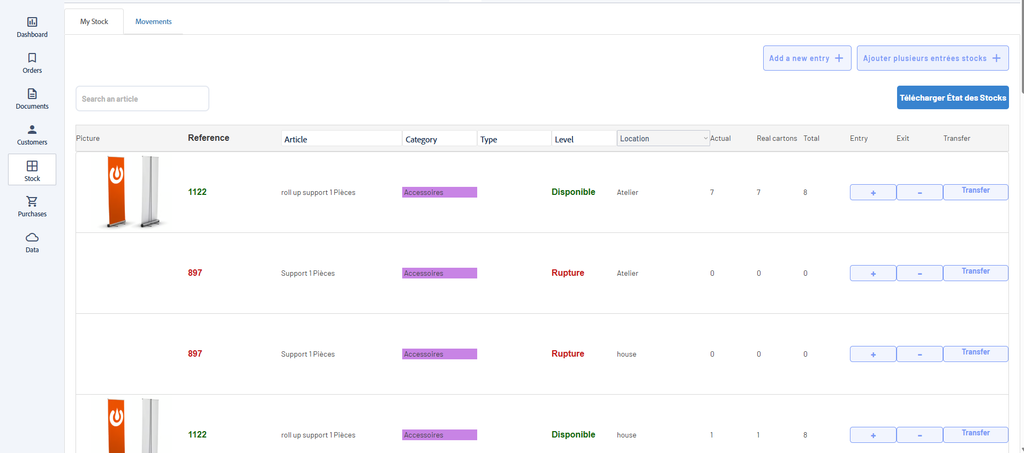
Track incoming and outgoing goods continuously across all your storage locations. Inventory levels are automatically updated after every order, purchase, or sale.
You can immediately view available quantities by location, keep orders synchronized with inventory levels, and receive replenishment alerts.
Inventory counting remains an essential step for any business handling goods. When properly organized, it helps secure data, optimize logistics flows, and improve profitability management.
However, traditional methods are showing their limitations in the face of today’s requirements for responsiveness and reliability. Digitizing this process helps businesses improve accuracy, efficiency, and visibility.
With a tool like Logistiqa, inventory counting naturally becomes part of day-to-day business management. Companies benefit from reliable, shared, and immediately actionable information to improve their performance.
FAQ
How do you conduct an inventory count?
Conducting an inventory count involves physically counting the products available and then comparing these quantities with the figures recorded in your management system. Any discrepancies are then analyzed and corrected to ensure reliable inventory data.
What are the different types of inventory counts?
There are three main types of inventory counts: physical inventory (one-time counting), cycle counting (spread throughout the year by areas or items), and perpetual inventory (continuous updates after every inventory movement).
How do you prepare for an inventory count?
Proper preparation involves clearly organizing storage areas, identifying products, defining a standardized counting method, and scheduling an appropriate time slot to minimize disruption to business operations.
What are the steps involved in an inventory count?
An inventory count generally consists of five steps:
- Preparation: organize storage areas, freeze inventory movements if necessary, and define the schedule.
- Identification: verify item references, locations, and counting units.
- Method: apply a clear and consistent counting procedure across all teams.
- Double counting: verify quantities for sensitive items or whenever discrepancies are identified.
- Finalization: reconcile the results with theoretical inventory, analyze discrepancies, and validate the necessary adjustments.
Contact us by email info@logistiqa.co
Posts navigation
←Overstocking: How to Avoid It and What to Do When It Happens ?