Inventory Optimization: A Guide to Best Practices

Inventory management is often one of the biggest challenges for businesses that sell products, yet it is far from easy to get right. Many small and medium-sized businesses have experienced mistakes in replenishment or inventory management. To minimize these issues, it is essential to implement an effective inventory optimization strategy. To help you do so, here are some of the best practices to follow.
Inventory Optimization: What Is It?
Inventory optimization involves strategically adjusting inventory levels based on customer demand, helping to avoid stockouts and excess inventory.
The goal is to find the best possible balance between supply and demand in order to reduce costs and increase profits.
Why Optimize Your Inventory?
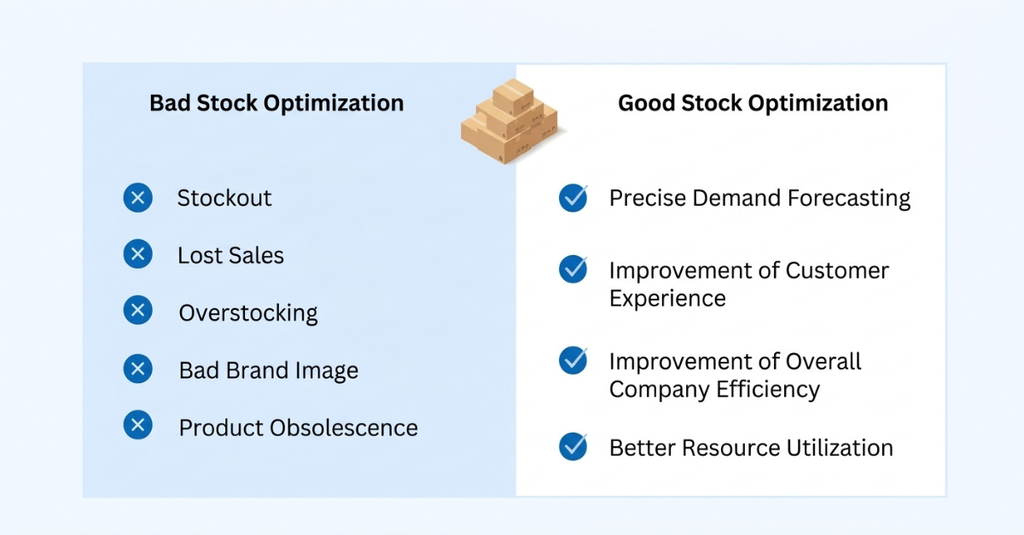
Poor inventory management can have serious consequences: stockouts, missed sales, a damaged brand image, capital tied up in excess inventory, and, in some cases, product obsolescence.
As you can see, inventory optimization is essential to avoid these issues, but it also offers several benefits:
- You increase your profits: by accurately anticipating demand, you avoid excess inventory and tying up capital that could instead be invested in growth initiatives.
- You improve the customer experience and satisfaction: when customers can get your products without unnecessary delays, you reduce frustration and help build customer loyalty.
- You optimize your operations: both stockouts and excess inventory can disrupt your operational workflow. By limiting both through effective inventory optimization, you improve the overall efficiency of your business.
Inventory Optimization: Best Practices
Find the Right Replenishment Method
There are four replenishment methods. You should choose the one that best suits your business:
- The calendar-based method: Since it follows a fixed schedule with set dates and quantities, it is suitable for businesses whose sales volumes vary little.
- The order-based replenishment method: This is ideal for businesses with irregular or seasonal sales. Both replenishment dates and quantities can vary depending on demand.
- The replenishment-to-target method: This method is well suited to businesses whose products sell well but are expensive, bulky, or perishable. Replenishment dates vary and are based on the number of sales made.
- The reorder point method: This method is slightly more flexible than the calendar-based approach. Replenishment quantities remain fixed, but the order date varies depending on the inventory level.
Organize and Label Your Inventory
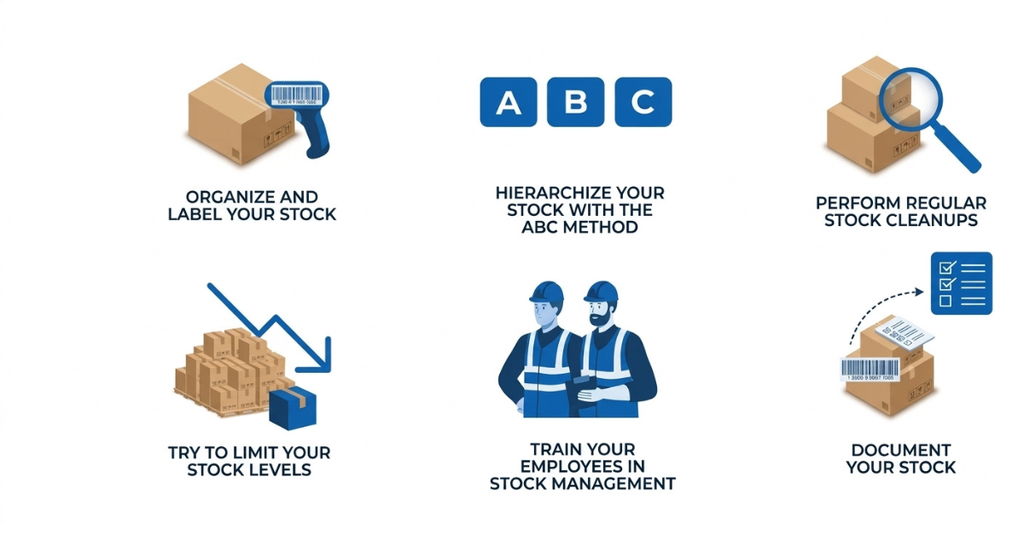
The best way to keep your inventory organized is to make sure every product in your warehouse is properly labeled. This gives you quick access to essential product information, such as expiration dates, the presence of hazardous materials, storage and packaging requirements, and more.
Pay close attention to how you name your inventory! Every label should have a clear and specific meaning. Create an organizational system with categories and subcategories, and make sure every employee understands what each designation refers to. This will help reduce the risk of errors.
Prioritize Your Inventory with the ABC Method
The ABC method allows you to categorize your inventory into three classes based on value. The process is very simple:
- A: the most important inventory items, corresponding to your best-selling products;
- B: moderately important items;
- C: the least important items.
This helps you set priorities and focus your efforts where they matter most. Category A items should never run out of stock.
Easy to implement, this method helps streamline inventory management and make better decisions about where to allocate your resources.
Regularly Review and Clean Up Your Inventory
Here, we encourage you to carry out regular inventory counts to make sure you are not keeping obsolete stock in your warehouse that is unlikely to ever be sold. Much like a spring cleaning, you need to determine what is no longer useful and what should be kept.
Regular inventory counts will also help you clearly identify new, mature, and end-of-life stock, allowing you to manage each category more effectively.
Try to Keep Inventory Levels Under Control
As mentioned earlier, excess inventory is one of the biggest challenges for businesses that sell products. To reduce your costs and optimize inventory, try to keep the quantity of items in stock as low as possible.
We know this can be difficult. It is all about finding the right balance between production levels and a good understanding of your customers and products. You need to make sure your customers can always find what they are looking for, whether in-store or online, without keeping more merchandise than necessary.
You should implement just-in-time replenishment so that you can adjust inventory levels according to your orders.
To achieve this, you need to establish an effective process for managing orders and delivery times. You can use the inventory management methods mentioned above and/or rely on inventory management software. If you have not yet digitized your inventory optimization process, now is the time to do it!
Train Your Employees in Inventory Management
How can you maintain effective inventory optimization if your teams are not properly trained in your organizational system and best practices? You should invest in training employees who work directly with inventory, whether they are in the warehouse or managing stock from a computer.
When employees fully understand your inventory system, storage methods, and automation processes, you can minimize human error and maintain better inventory management. Once they are trained, do not hesitate to provide regular refreshers, especially when your processes change or order volumes increase.
One final tip: limit access to your inventory and warehouse as much as possible. Only employees whose responsibilities require it should handle the merchandise. This will help prevent disorganization and reduce errors.
Document Your Inventory
Without a documented inventory management process, it is difficult to maintain accurate and consistent stock tracking over time. All merchandise movements, including orders, as well as important information such as defective products and low stock levels, should be recorded accurately and systematically. Ideally, you should digitize your inventory records and update them as regularly as possible.
You should also make this information accessible to your inventory management teams and ensure they know how to use it properly. For this, nothing is more effective than using inventory management software.
Use Management Software to Track Your Inventory More Effectively
Effective inventory management starts with clear, up-to-date information. When purchases, sales, and product movements are tracked manually, it becomes harder to know what has been purchased, sold, or is still available.
Management software allows you to centralize this information and make daily operations easier to monitor. With Logistiqa, you can manage your purchases, sales, and products from a single platform. Every recorded transaction helps you maintain better visibility over your business and quickly find the information you need.
Logistiqa also allows you to track customers, suppliers, expenses, quotes, invoices, delivery notes, and purchase orders. This gives you a more structured view of your operations without having to manage multiple Excel files or paper documents.
For a small business, SME, or cooperative, the goal is simple: reduce manual tasks, minimize errors, and save time on day-to-day management. By centralizing your data, you can more easily monitor purchasing and sales activities and make decisions based on better-organized information.
Logistiqa helps you take your business management digital with a simple solution designed to make day-to-day operations easier to manage.
Contact us by email info@logistiqa.co