
Break-Even Point Calculation: Discover the Formula

If you are about to start or acquire a business, you have probably heard of the concept of the break-even point. In many ways, it acts as a compass for business owners. More specifically, it tells you how much revenue your company needs to generate before it starts making a profit. It is therefore a key indicator for the growth and long-term sustainability of any business. But how do you calculate it? That is what we are going to explore in this article.
Break-Even Point: What Is It and Why Does It Matter?
Before explaining how to calculate the break-even point, it is important to understand what it is used for.
Every business has a certain level of expenses each month. The break-even point represents the minimum revenue a company needs to generate over a given period to cover all of its expenses. It is the point at which the company’s total revenue exactly covers its total costs.
In simple terms, when a company reaches its break-even point, it makes neither a profit nor a loss. Below this point, the business operates at a loss; above it, it starts generating a profit—which is, of course, good news.
As you can see, the break-even point is a key performance indicator that deserves close attention, especially when starting a business or looking for financing. It is commonly included in important financial documents, such as a business plan or financial projections.
It also remains essential throughout the development and management of a business. It gives you a clear target to reach over a specific period. Once you have calculated it, you can use it to guide your sales strategy and set realistic sales targets.
By calculating your break-even point, you can make more informed business decisions, support sustainable growth, and maintain financial stability.

Maintenant que vous comprenez son importance, voyons comment le calculer correctement.
Comment calculer le seuil de rentabilité ?
La formule de calcul du seuil de rentabilité
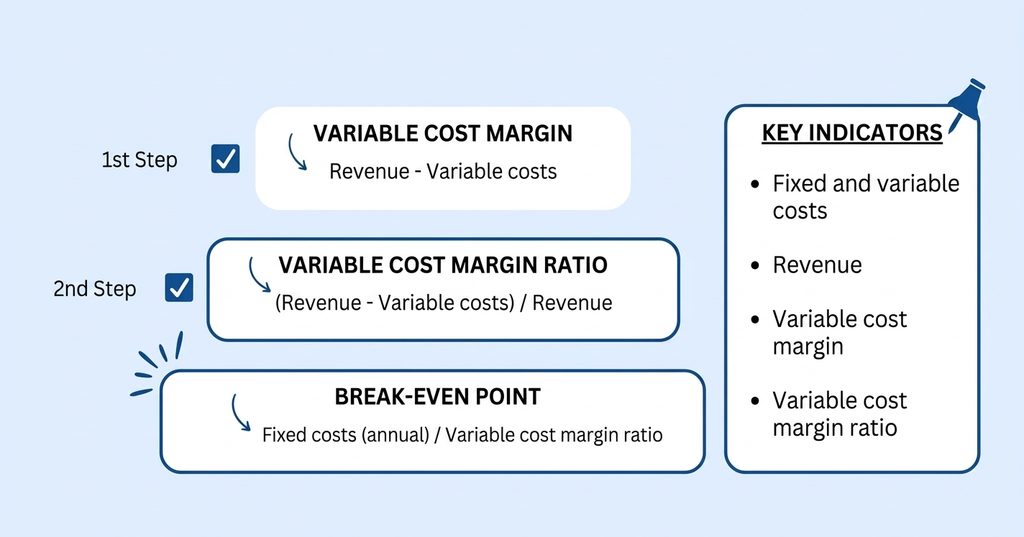
Pour calculer le seuil de rentabilité, la formule est la suivante :
Seuil de rentabilité = Charges fixes annuelles / Taux de marge sur coûts variable
Ce calcul se fait entre 3 étapes :
- vous devez d’abord déterminer toutes vos charges, à la fois fixes et variables ;
- ensuite, vous devez définir votre taux de marge du coût variable ;
- enfin, vous devez déterminer votre chiffre d’affaires minimum à réaliser pour atteindre votre seuil de rentabilité.
Découvrons en détails tous ces indicateurs essentiels au calcul du seuil de rentabilité.
Zoom sur les indicateurs indispensables pour calculer le seuil de rentabilité
Les charges fixes et variables
Les charges fixes correspondent à toutes les dépenses que l’entreprise devra couvrir quoi qu’il arrive. Par exemple :
- le loyer des bureaux ou des locaux ;
- le crédit-bail ;
- les honoraires comptables et juridiques ;
- les intérêts des crédits ;
- les primes d’assurance ;
- les factures téléphoniques ;
- les salaires et charges sociales salariales ;
- etc.
Les charges variables, quant à elles, sont celles qui évoluent en fonction de votre chiffre d’affaires et de votre niveau d’activité. Concrètement, plus vous faites du chiffre, plus vos charges augmentent et inversement.
L’enjeu ici est de savoir les mesurer et les anticiper le plus précisément possible pour calculer le seuil de rentabilité. Il s’agit par exemple :
- des marchandises ;
- des matières premières ;
- de vos charges en transport et logistique ;
- de vos achats de fournitures consommables et matériaux ;
- etc.
Le chiffre d’affaires
En cas de création d’entreprise, vous ne connaissez pas votre chiffre d’affaires. Vous devrez, dans votre business plan, déterminer un chiffre d’affaires minimum atteignable basé sur vos prédictions et vos services/produits.
La marge du coût variable
La marge du coût variable détermine votre capacité à couvrir vos charges fixes et générer du bénéfice. C’est ni plus, ni moins, un indicateur de rentabilité.
Pour la calculer, voici la formule :
Chiffre d’affaires – Charges variables
Taux de marge sur coûts variables
Ce taux permet de définir le pourcentage de gain ou de perte pour chaque vente et prestation réalisée.
Pour le calculer, utilisez cette formule :
Taux de marge sur coûts variables = (Chiffre d’affaires – Coûts variables) / Chiffre d’affaires
Example of a Break-Even Point Calculation
Let’s imagine that you run a craft cooperative generating MAD 280,000 in revenue. Your fixed costs amount to MAD 50,000, while your variable costs total MAD 112,000.
You would therefore make the following calculations:
- Contribution margin: 280,000 − 112,000 = MAD 168,000
- Contribution margin ratio: 168,000 / 280,000 = 0.60
- Break-even point: 50,000 / 0.60 = MAD 83,333.33
The break-even point is therefore reached once the business generates MAD 83,333.33 in revenue.
A useful tip
Round your fixed costs up to allow for potential increases in expenses over time. Once you have calculated your break-even point, consider adding a 5% to 10% safety margin to account for potential risks and unexpected costs.
One thing is certain: you should regularly adjust your break-even point as your business evolves. This is especially important when your expenses increase, for example, when moving to a larger office, hiring new employees, or investing in new equipment.
Break-Even Point and Break-Even Date: What’s the Difference?
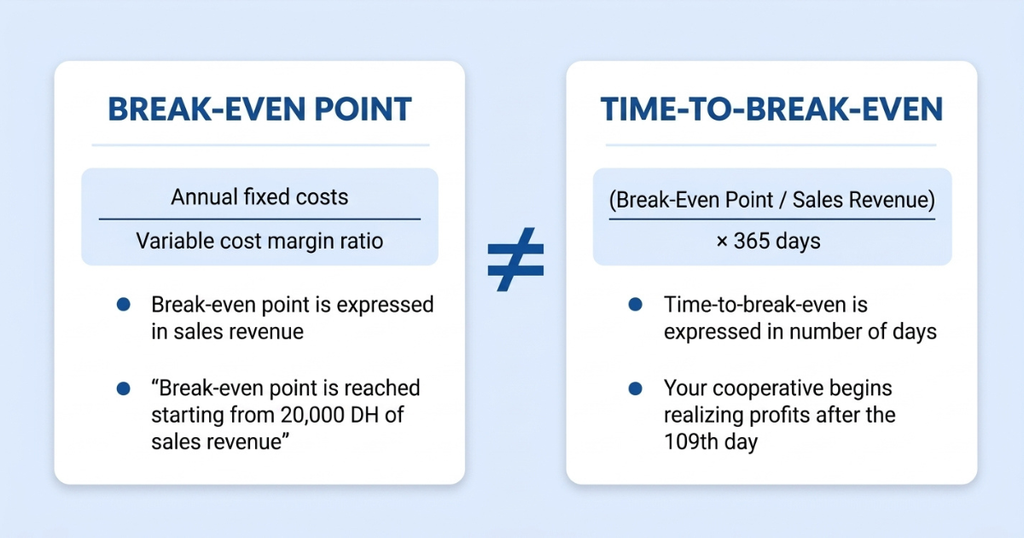
The break-even date is often mentioned alongside the break-even point because the two concepts are closely related, but they are not the same. It is important to use both concepts correctly and avoid confusing them. Simply put, calculating the break-even date allows you to determine when your cooperative reaches its break-even point—that is, when it starts becoming profitable.
The break-even date is expressed in number of days, and the formula used to calculate it is:
Break-Even Date = (Break-Even Point / Revenue) × 365 days
Let’s calculate the break-even date using our previous example:
(83,333.33 / 280,000) × 365 days
Your cooperative will start generating a profit after the 109th day.
Why Improving Your Break-Even Point Matters
If one of your business activities is not generating enough profit, consider putting it on hold so you can focus on more profitable segments. This decision may be appropriate when measures such as cutting expenses and restructuring the activity have not produced the expected results.
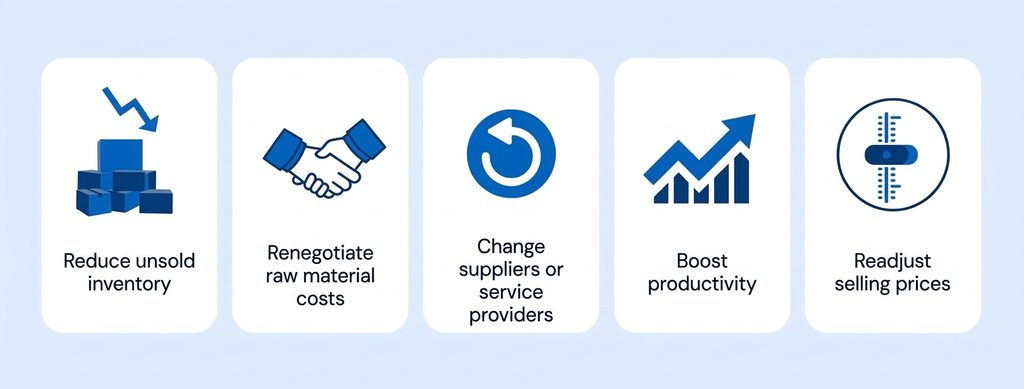
There are several ways to improve your overall profitability, including increasing your profit margin and reducing variable or fixed costs. Here are some effective strategies:
- Reduce unsold inventory;
- Renegotiate the cost of raw materials;
- Change suppliers or service providers;
- Improve productivity;
- Adjust your selling prices.
These measures require a thorough assessment of the cost structure and a clear understanding of market dynamics to effectively optimize revenue.
With its advanced inventory management features, Erplain can help you optimize your inventory and manage your small business in real time.
Break-Even Point Calculation FAQ
What is the break-even point?
The break-even point is the minimum revenue a business needs to generate to cover all of its fixed and variable costs. Once this point is reached, the business makes neither a loss nor a profit. Beyond this threshold, it starts generating a profit.
What Is the Break-Even Point Formula?
The break-even point is calculated using the following formula:
Break-Even Point = Fixed Costs / Contribution Margin Ratio
The contribution margin ratio is calculated as follows:
(Revenue − Variable Costs) / Revenue
What Is the Difference Between the Break-Even Point and the Break-Even Date?
The break-even point indicates the amount of revenue a business needs to generate to become profitable. The break-even date indicates when, or after how many days, that threshold will be reached.
The formula is:
Break-Even Date = (Break-Even Point / Annual Revenue) × 365
What Costs Should Be Included in the Calculation?
The calculation should include fixed costs, such as rent, salaries, insurance, and subscriptions, as well as variable costs that fluctuate with the level of business activity, such as merchandise purchases, raw materials, transportation, and commissions.
How Do You Calculate the Break-Even Point When Starting a Business?
When there is no actual revenue yet, the calculation is based on the financial projections in your business plan. You need to estimate your fixed costs, variable costs, and projected revenue based on your selling prices, expected sales volumes, and market conditions.
How Often Should You Recalculate Your Break-Even Point?
It is recommended to recalculate your break-even point at least once a year, but also whenever a significant change occurs in your business, such as hiring new employees, increases in supplier prices, moving to new premises, making a new investment, or changing your selling prices.
How Can You Lower Your Break-Even Point?
A business can lower its break-even point by reducing its fixed costs, controlling its variable costs, or improving its profit margin. This can include renegotiating purchasing costs, reducing unsold inventory, optimizing business processes, or adjusting selling prices.
Is a High Break-Even Point a Bad Thing?
A high break-even point means that a business needs to generate significant revenue before it starts making a profit. This can increase its exposure to fluctuations in business activity. However, this indicator should always be assessed in relation to the company’s industry, business model, and profit margin.
How Does Inventory Management Affect the Break-Even Point?
Inventory ties up cash and generates storage, handling, and depreciation costs. Better management of purchasing, inventory levels, and unsold products can help reduce variable costs and improve the company’s overall profitability.
Contact us by email at info@logistiqa.co.
Post Navigation
← Barcodes by Country?